
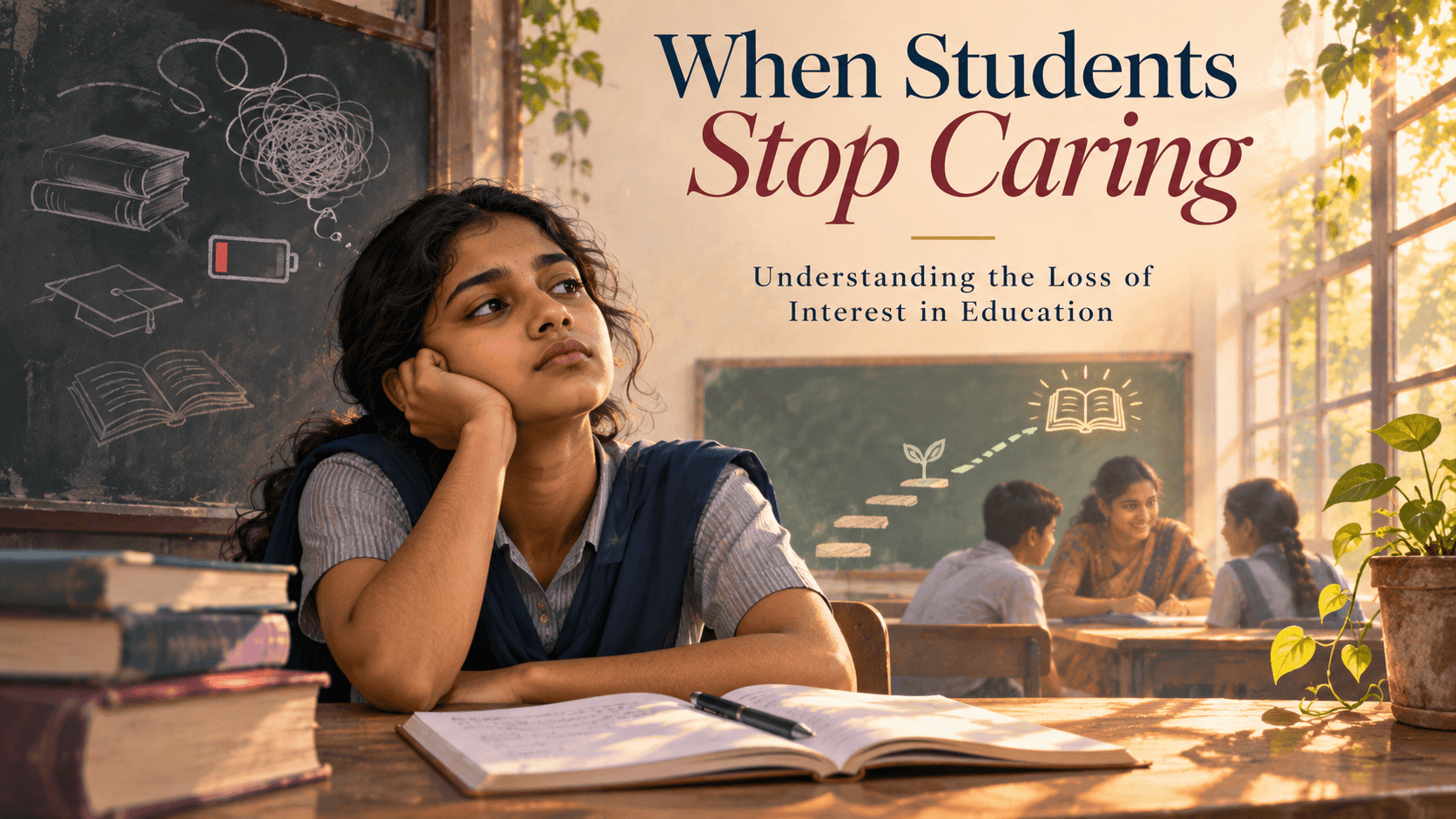
A Research Report on Causes, Systemic Barriers, Disengagement Dynamics, and Strategic Interventions
This report examines why students gradually lose interest in education, the warning signs that may precede withdrawal, and responses that schools, families and community organisations can consider. It places particular emphasis on foundational learning, emotional belonging, practical career exposure and student-centred support.
Submitted by Aasif Ayoub · Research & Publication Intern · 11 September 2026
Introduction
Student disengagement and the gradual loss of interest in formal education represent one of the most pressing socio-educational challenges in contemporary society. Far from being a sudden decision or a personal failure of willpower, academic disengagement is a complex, cumulative process. Students rarely wake up one day and arbitrarily decide to abandon their education; rather, they undergo a progressive withdrawal driven by systemic, institutional, socio-economic, and psychological pressures.
In developing nations, particularly across rural and semi-urban landscapes in India, this phenomenon presents severe developmental consequences. According to global and national datasets from UNESCO and the Ministry of Education, millions of children drop out or remain functionally disengaged within classrooms every year. The primary objective of this research paper is to investigate the foundational root causes of why students lose interest in schooling, examine early warning indicators, assess the long-term impact on personal and national development, and construct actionable, empathetic solutions. Crucially, this study approaches the issue through a structural and student-centric lens—seeking to understand the underlying mechanics rather than placing blame on the learner.
Understanding Student Disengagement
Academic disengagement is defined as the process through which a student progressively detaches from the academic, social, and emotional aspects of schooling. Educational research (Fredricks, Blumenfeld, & Paris, 2004) categorizes disengagement into three interconnected dimensions:
- Behavioral Disengagement: The absence of active participation, characterized by poor attendance, lack of effort, non-submission of classwork, chronic tardiness, and disruptive classroom behavior.
- Emotional Disengagement: The presence of negative feelings towards school, including chronic boredom, anxiety, alienation, apathy, and a pervasive feeling that school is irrelevant or hostile.
- Cognitive Disengagement: The lack of mental investment, failure to set learning goals, reliance on rote memorization without comprehension, and passive compliance without deep cognitive processing.
Early Warning Indicators of Disengagement
Identifying early warning signs allows educators and institutions to intervene before academic withdrawal becomes irreversible. Early warning signals typically manifest across three primary domains:
| Domain | Early Warning Indicators | Underlying Psychological State |
|---|---|---|
| Academic | Sudden drop in grades, incomplete homework, failure to participate in class discussions, test avoidance. | Learned helplessness, fear of failure, or unaddressed learning gaps. |
| Behavioral | Chronic tardiness, unexcused absences (truancy), head on desk during instruction, frequent classroom exit requests. | Avoidance mechanisms, apathy, or physical/mental exhaustion. |
| Social-Emotional | Isolation from peers, expression of cynicism regarding the value of school, lack of extracurricular involvement, flat affect. | Sense of alienation, low self-efficacy, or severe socio-economic stress. |
Causes of Loss of Interest in Education
The erosion of academic interest is multifaceted. Research highlights six key drivers that contribute to student disengagement:
Academic Difficulties and Unaddressed Learning Gaps
When students fall behind in foundational concepts—particularly literacy and numeracy—subsequent instruction becomes incomprehensible. In traditional rigid curricula, teachers are forced to move forward based on syllabus deadlines rather than student mastery. This creates a compounding effect where struggling students experience chronic failure, leading to learned helplessness—a psychological state where the student believes that no amount of effort will produce success.
Lack of Intrinsic Motivation and Self-Confidence
Motivation in education relies heavily on academic self-efficacy—a student’s belief in their ability to succeed. Rote-based learning environments that reward speed and memorization over critical thinking frequently undermine self-confidence in non-traditional learners. When internal motivation yields to continuous negative reinforcement, students protect their self-worth by withdrawing effort entirely.
Socio-Economic and Household Challenges
Educational outcomes are deeply tied to socio-economic contexts. Poverty introduces severe external stress: domestic instability, household chores, need for informal employment, nutrition deficits, and lack of dedicated study spaces at home. According to NCERT and UNICEF studies, financial constraints force families to view education through an immediate opportunity-cost framework, often prioritizing immediate wage-earning over long-term schooling.
Peer Dynamics and Negative Social Factors
During adolescence, peer influence strongly dictates behavior. Students who experience bullying, social exclusion, or stigmatization in school often develop severe anxiety surrounding the learning environment. Furthermore, when a peer group normalizes truancy or trivializes academic effort, individual students frequently align with group norms to secure social belonging.
Disconnect from Career Trajectories
A primary driver of disengagement is the perceived abstract nature of school curricula. Students are routinely asked to master theoretical concepts without understanding their practical real-world application or connection to sustainable livelihoods, creating a profound gap between schooling and future economic independence.
Examination Stress and High-Stakes Pressure
An over-emphasis on high-stakes examinations creates an environment dominated by evaluation anxiety. When education is reduced to test scores, learning loses its intrinsic joy. Students who consistently score lower than their peers are often labeled as 'weak,' reinforcing negative self-perceptions and precipitating complete emotional withdrawal.
The Career & Purpose Gap ("Why Should I Study?")
One of the most recurring dilemmas among secondary school students is the 'Why Should I Study?' problem. Educational institutions often assume that students inherently understand the value of academic credentials; however, for millions of first-generation learners, the connection between abstract textbooks and employment remains invisible.
The Disconnect Between Schooling, Skills, and Livelihoods
Traditional schooling frequently emphasizes academic theory over functional, real-world skill development. Students spend years memorizing formulas without acquiring practical competencies such as digital literacy, communication, problem-solving, or vocational expertise. Consequently, when students look at high youth unemployment rates among educated graduates, they question the economic return on investment (ROI) of remaining in school.
The Role of Early Career Awareness and Exposure
Structured career guidance serves as a critical bridge between classroom engagement and future aspirations. Research demonstrates that when students understand specific career pathways—and comprehend how current coursework (such as mathematics or language arts) directly enables those pathways—their academic engagement increases significantly. Career awareness transforms education from an externally imposed chore into an intentional pathway toward self-actualization.
Consequences of Disengagement
The consequences of unaddressed student disengagement extend far beyond individual report cards, creating compounding negative impacts across individual lives and broader society:
- Academic Decline and Skill Stagnation: Persistent disengagement leads to severe learning losses, resulting in functionally illiterate or innumerate adolescents who lack essential problem-solving abilities.
- Chronic Absenteeism and School Dropout: Unaddressed disengagement is the single strongest precursor to permanent dropouts. Disengaged students gradually increase truancy until complete departure from the formal education system occurs.
- Reduced Livelihood Opportunities: Early exit from education locks individuals into low-skill, informal sector labor with poor job security, perpetuating intergenerational cycles of poverty.
- Social and Behavioral Risks: Disengaged youth who drop out face higher vulnerability to substance abuse, juvenile delinquency, exploitation, and mental health challenges due to lack of structured social support.
Possible Solutions
Rebuilding student engagement requires a coordinated effort across schools, families, civil society organizations, and policy-makers. Key evidence-based solutions include:
- Structured Mentorship Programs: Pairing disengaged students with trusted adult mentors or peer leaders provides emotional validation, goal-setting framework, and academic accountability.
- Early Career Guidance and Exposure: Integrating vocational training, industry visits, interaction with professionals, and practical skill workshops directly into secondary school curricula.
- Targeted Remedial Academic Support: Implementing Teaching at the Right Level (TaRL) approaches to bridge foundational learning gaps without causing shame or peer stigma.
- Practical and Experiential Learning: Shifting pedagogical models from passive lecture/memorization to activity-based, hands-on, problem-solving formats that make learning tangible.
- Comprehensive School Counselling: Providing socio-emotional counselling services within schools to address trauma, home stress, anxiety, and peer conflict.
- Active Parent-Community Involvement: Engaging parents through constructive regular interactions, educating households on the long-term value of education, and building supportive home environments.
Recommendations for V Devi Foundation
To address student disengagement effectively within its target communities, V Devi Foundation can implement the following 8 actionable, high-impact programmatic initiatives:
Project 'Sankalp' - Community Mentorship Network
Establish a community-based mentorship initiative connecting college students and young professionals with at-risk secondary students. Mentors meet weekly to offer emotional support, academic encouragement, and personal guidance.
Career Awareness & Vocational Exposure Camps ('Disha')
Organize bi-monthly interactive career workshops introducing diverse career pathways, vocational trades, digital skills, and entrepreneurial opportunities, helping students connect classroom education to real-world careers.
Foundational Learning Remediation Centers
Deploy localized after-school learning support centers utilizing the Teaching at the Right Level (TaRL) methodology to assist students who have fallen behind in basic literacy and numeracy.
Student Mental Health & Emotional Wellness Circles
Introduce safe-space group counselling sessions facilitated by trained socio-emotional counsellors to address examination stress, family pressures, self-esteem issues, and peer conflict.
Experiential & Activity-Based STEM Workshops
Conduct practical hands-on science and math workshops featuring simple kit-based experiments, digital tools, and real-world application projects to rekindle curiosity and intrinsic joy in learning.
Parent Engagement & Educational Value Orientation
Host quarterly community workshops for parents to build awareness regarding non-punitive parenting, domestic study support, and the long-term economic benefits of keeping children in school.
Early Warning & Retention Tracking System
Develop a simple digital or register-based tracking tool for partner schools to flag early indicators (attendance drops below 75%, failing grades) enabling rapid foundation intervention.
Youth Leadership & Peer Buddy Program
Train motivated students as 'Peer Ambassadors' who can identify struggling classmates, foster inclusive peer groups, and encourage regular school attendance through positive social support.
Student Perspectives (Case Studies)
To ground this research in lived realities, anonymous feedback was gathered from secondary school students facing academic disengagement:
Case Study 1: Student A (Age 15, Grade 10)
"I lost track of math in Grade 7 during online/disrupted classes. Now when the teacher writes on the board, I don't understand anything. I sit in the back row so I won't be called on. I feel like school is just a place where I get reminded that I am slow."
Case Study 2: Student B (Age 16, Grade 11)
"Everyone asks me to study hard for exams, but nobody tells me what I will do after school. My family wants me to earn money soon. If school taught me actual job skills like computing or mechanics, I would care a lot more."
Case Study 3: Student C (Age 14, Grade 9)
"My parents argue constantly about money at home, and I have to look after my younger siblings. By the time I sit down to study, I'm exhausted. When teachers scold me for incomplete work, I just want to stop coming altogether."
Conclusion
Student disengagement is not an inevitable reality nor a personal flaw of the learner; it is a clear diagnostic signal of systemic disconnects between student needs and educational environments. When students stop caring about education, it is usually because education has ceased to feel achievable, relevant, or safe to them. By shifting from punitive approaches to empathetic, structural interventions—combining foundational academic remediation, comprehensive mentorship, practical career guidance, and community engagement—organizations like V Devi Foundation can effectively bridge the purpose gap, restore confidence, and rebuild meaningful educational journeys for vulnerable students.
References / Sources
- Bandura, A. (1997). Self-efficacy: The exercise of control. W. H. Freeman and Company.
- Fredricks, J. A., Blumenfeld, P. C., & Paris, A. H. (2004). School engagement: Potential of the concept, state of the evidence. Review of Educational Research, 74(1), 59-109. View source
- Ministry of Education, Government of India. (2020). National Education Policy 2020. New Delhi: Ministry of Human Resource Development. View source
- NCERT. (2021). National Achievement Survey (NAS) Report: Assessment of Student Learning Outcomes. National Council of Educational Research and Training, New Delhi. View source
- Pratham Education Foundation. (2023). Annual Status of Education Report (ASER) 2023: Beyond Basics. New Delhi: Pratham. View source
- Rumberger, R. W. (2011). Dropping Out: Why Students Drop Out of High School and What Can Be Done About It. Harvard University Press. View source
- UNESCO. (2020). Global Education Monitoring Report 2020: Inclusion and education — All means all. Paris: UNESCO. View source
- World Bank, UNESCO, & UNICEF. (2021). The State of the Global Education Crisis: A Path to Recovery. Washington, DC: World Bank. View source